
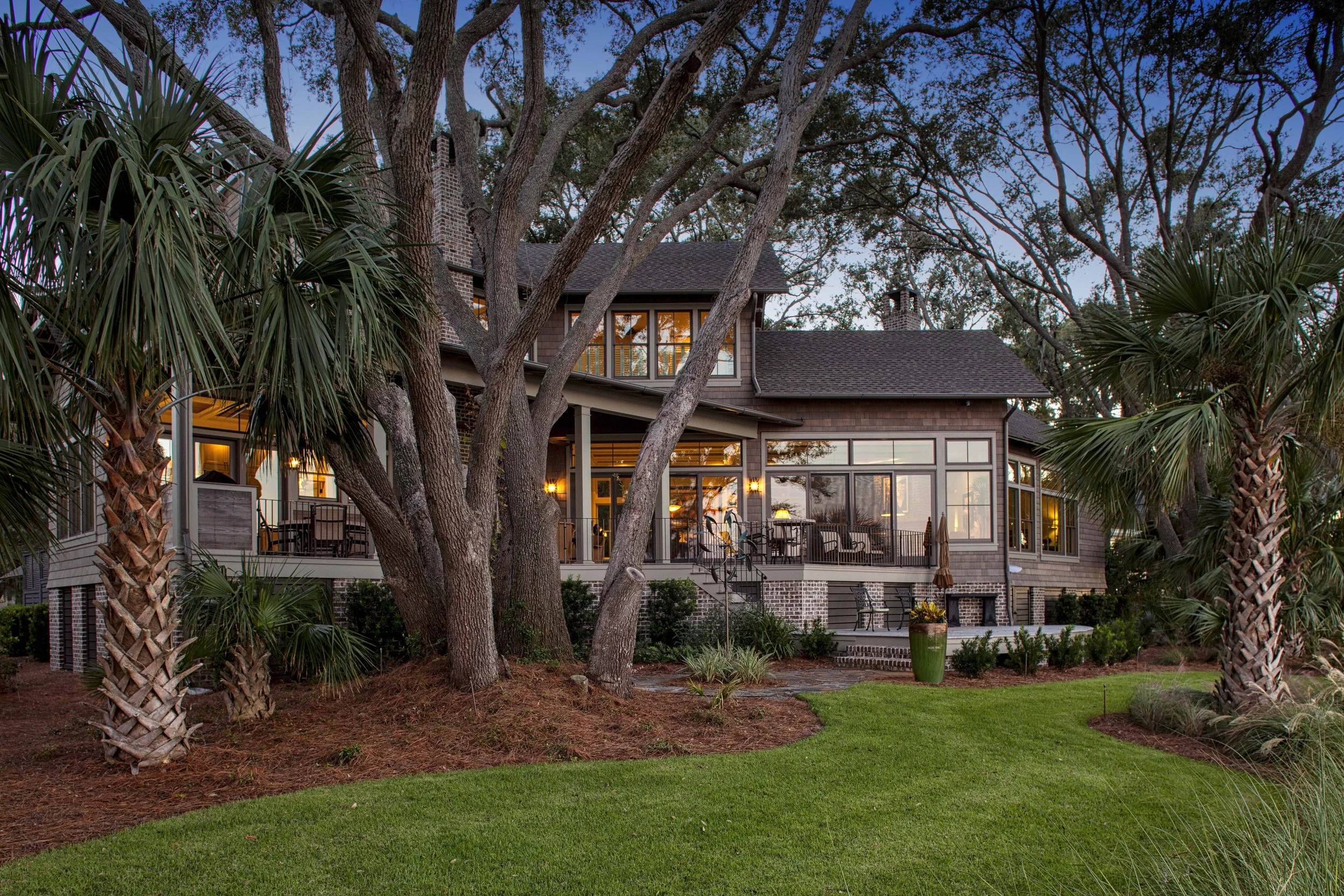
Why Realtors Should Have an Architect on Speed Dial
Realtors called this live oak lot unbuildable. Here’s what an architect saw instead, and what to look for before your clients buy.

Net Zero in the Lowcountry: What Does It Take?
Net zero gets sold as a solar panel count, but the real work happens before generation ever enters the conversation. Here's why the envelope, orientation, and mechanical systems have to be right first, and what that looks like in a working Lowcountry home.

How to Choose the Right Architect for Your Lowcountry Home
Building a custom home on the South Carolina coast is one of the most significant investments of your life — and the architect you choose shapes everything that follows. This guide from Frederick + Frederick Architects covers what to look for beyond the portfolio: climate expertise, construction administration, credentials that actually signal depth, and the questions worth asking in every interview. Written for those building or retiring to Beaufort, Bluffton, Hilton Head, or the Sea Islands. | Lowcountry architecture | custom home design | coastal South Carolina | retirement home planning

Rooftop Solar in South Carolina: The Case for Energy Independence
The conversation around rooftop solar has shifted. Without federal tax credits sweetening the deal, homeowners are asking a more fundamental question: why go solar? For us in coastal South Carolina, the answer has always been bigger than a tax break, it's about taking control of your own energy future.


How to Evaluate a Coastal Lot Before You Buy
If you are planning to build a custom home in the South Carolina Lowcountry, choosing the right lot is the single most consequential decision you will make. The landscape here is unlike anywhere else: tidal creeks winding through ancient marsh grass, live oaks draped in Spanish moss, and water views that shift with the light and the tide. For many buyers, finding the right piece of land feels like the beginning of something they have been planning for years.

Is Building to Code Good Enough?
I write often about building science because our industry repeats myths that sound reassuring but do not hold up in practice. One of the most persistent is this: if a house meets code, it must be good enough.
It is not.
Building codes establish the legal minimum, not the level required for comfort, durability, or resilience. This gap is especially risky in hot, humid, storm-prone regions like the Southeast.

FORTIFIED for the Coast
Advances in building science now offer a clear path to stronger coastal homes through the FORTIFIED™ Home program developed by the Insurance Institute for Business & Home Safety. In hurricane-prone regions, FORTIFIED certification is quickly becoming the gold standard.
For homeowners, it delivers confidence and peace of mind. For architects, it provides a proven roadmap for creating homes that are not only beautiful but also durable enough to withstand the realities of coastal living.

Why "House Burping" Is Not the Indoor Air Quality Solution We’ve Been Waiting For
If you’ve been on TikTok or Instagram lately, you’ve probably seen the latest home wellness trend: “house burping.” The advice is simple. Open your windows for five minutes several times a day to “air out” your house and improve indoor air quality.
It sounds harmless. Even sensible. The idea has gained so much traction that NPR and The New York Times have covered it.
As an architect who designs houses for hot, humid climates, I’ll say this plainly:
For most homes, in most climates, this is bad advice.

Book Tour
Southern vernacular architecture is rooted in pragmatism: its forms, materials, and spatial logic evolve from climate, landscape, and way of life. In our coastal Lowcountry, traditions like raised piers, deep porches, narrow floorplates, and cross‑ventilation were not aesthetic afterthoughts; they were essential strategies for comfort and resilience.

Modern Takes on Southern Vernacular: A Fresh Voice for Lowcountry Living
Southern vernacular architecture is rooted in pragmatism: its forms, materials, and spatial logic evolve from climate, landscape, and way of life. In our coastal Lowcountry, traditions like raised piers, deep porches, narrow floorplates, and cross‑ventilation were not aesthetic afterthoughts; they were essential strategies for comfort and resilience.

Designing to Withstand Storms: How Research, Best Practices, and FORTIFIED Standards Shape Resilient Homes
Living and building near the coast means confronting storms mightily. The goal isn’t merely survival, but resilience: limiting damage, reducing downtime, and enabling faster recovery.

Designing Homes for Hot, Humid Climates: Comfort, Resilience, and Beauty
Designing for hot, humid climates is a holistic process. It combines the laws of physics with client-centered design, tradition with innovation, and beauty with durability. The result is a home that feels right in every sense. It is cool, comfortable, resilient, and undeniably Lowcountry.

The Case for Resiliency
According to the National Institute of Building Sciences, hazard mitigation is one of the highest-return investments a community can make. Their widely cited 2017 report found that federally funded mitigation grants save the nation an average of $6 in future disaster costs for every $1 spent. Similarly, designing buildings to exceed select code requirements yields a $4 return for every $1 invested. More recent analyses suggest that depending on the type of resilience measure, the benefit-cost ratio can be even greater—ranging from $4 up to $11 for every $1 spent—underscoring the long-term value of proactive hazard mitigation.

Unbuildable Lots
Beaufort, like many coastal cities, has been experiencing high levels of development in recent years. There are less deep water, beachfront, or marsh view lots available now than there were when we started our firm. As a result, there are many lots that realtors and neighbors have given the bad reputation as being “unbuildable.” Here are a few case studies demonstrating how we’ve put in some extra effort to change that.

Connecting to the Land
In our book, Contemporary Southern Vernacular: Creating Sustainable Design for Hot, Humid Climates, we cover the importance of site design both from a sustainability viewpoint and connecting you to nature. The concept was a new one for many of our readers. One reader wrote, “Building a house to incorporate the surrounding landscape makes so much sense. I look out my window, and I am saddened that the builder did not position our house to catch a glimpse of the Pike’s Peak Mountain range, which is literally a few miles away. All I see out my window are houses. Some of the original landscapes would have been lovely to admire from my gigantic windows. Preserving Mother Nature and keeping it alive in our community would be a soothing and relaxing sight to awaken to every day.”

Designing for Hurricanes
As we enter into hurricane season, many people ask, “How can I build to mitigate hurricane damage?” Historically, we have worried more about hurricanes with high winds but Hurricane Florence proved that category 1 storms can be just as disastrous. Eight people in South Carolina died, property damage was over $607 million, and more than 2,000 homes were lost to flooding.
When building a new house there are three critical concerns in the design and construction in hurricane prone areas that address the simultaneous impacts of wind, rain, and flooding.

Construction Waste
Considering that 90% of waste is from demolition, it is imperative that we renovate and reuse buildings as opposed to tearing them down and starting from scratch. If a building must be taken down it should be deconstructed—meaning carefully dismantled to salvage materials for reuse and recycling.

The Science of Smart Materials
As we work to make our buildings more sustainable, selecting environmentally responsible building products and materials is critical to reducing the carbon footprint and building healthy buildings. To select materials wisely, we have to understand what is in them, how they were made, and if they can be recycled at the end of their usefulness.

Building Enclosures
Simply put, the building enclosure is the barrier between interior and exterior environments. Also referred to as the building envelope, it includes the walls, windows, doors, roof, and foundation. Comfort, natural lighting, ventilation, and energy use are all determined by the makeup of the building enclosure. It shouldn’t be a surprise that climate affects the optimal components, but a nuanced approach to building science was not adopted in our hot and humid south until the 21st Century! In a region where cooling is the primary concern over heating (though not exclusively), where significant rainfall events occur frequently, and where the humidity levels hover around steam room levels—specific building science must be applied.